 By
By 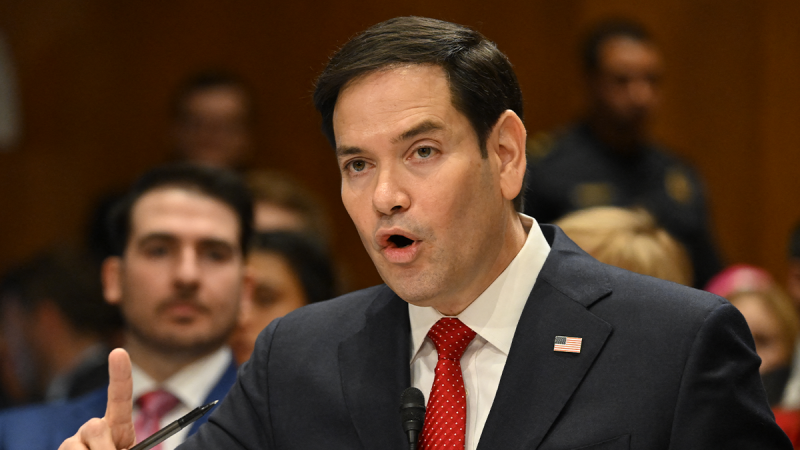
The U.S. is not preparing to utilize additional military force in Venezuela, but won’t hesitate to employ such force in the event of an ‘imminent threat,’ according to Secretary of State Marco Rubio.
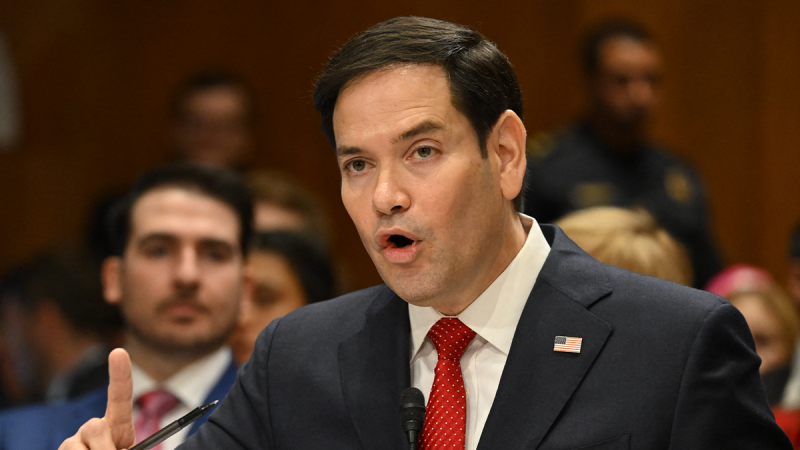
‘The president never rules out his options as commander-in-chief to protect the national interest of the United States,’ Rubio told lawmakers on the Senate Foreign Relations Committee Wednesday. ‘I can tell you right now with full certainty, we are not postured to, nor do we intend or expect to have to take any military action in Venezuela at any time. The only military presence you will see in Venezuela is our Marine guards at an embassy.’
That said, Rubio said that certain events could warrant military actions — pointing to a hypothetical scenario where an Iranian drone factory emerged in the region and threatened U.S. presence or allies there.
‘The president does reserve the option in self-defense to eliminate that threat,’ Rubio said. ‘We don’t see that, we don’t anticipate that, but it could happen. We hope not … But I think it would require the emergence of an imminent threat of the kind that we do not anticipate at this time.’
Rubio’s remarks came in response to questions about his prepared statement, which said that the U.S. is prepared to exert military force to ensure cooperation from Venezuela’s interim government if it defies Washington following the ouster of dictator Nicolás Maduro.
‘We are prepared to use force to ensure maximum cooperation if other methods fail,’ Rubio’s prepared testimony had said, which he ultimately did not end up using. ‘It is our hope that this will not prove necessary, but we will never shy away from our duty to the American people and our mission in this hemisphere.’
Rubio’s prepared testimony also maintained that there are no U.S. troops in Venezuela, and that the operation did not amount to waging a war in Caracas.
‘There is no war against Venezuela, and we did not occupy a country,’ Rubio said in his prepared remarks. ‘There are no U.S. troops on the ground. This was an operation to aid law enforcement.’
The move to ouster Maduro has attracted scrutiny, mostly from Democrats, who have called into question the legality of the operation in Venezuela, which was conducted without Congress’ approval.
But efforts in Congress to pass a war powers resolution that would have limited the Trump administration from conducting additional military action in Venezuela failed to pass earlier in January. Rubio previously has claimed Congressional approval wasn’t required because the operation was not an ‘invasion.’
On Wednesday, Rubio said that should U.S. military forces be involved in Venezuela in a ‘sustained’ way, Congress would receive notification 48-hours after the fact, and would be required to receive Congressional approval if the engagement lasted longer than 60 days.
Rubio also told lawmakers that Congress wasn’t consulted about the potential raid due to concerns from the Department of War about leaks, and because it wasn’t even a possibility to execute such a mission until late December 2025 after all negotiation efforts with Maduro had failed.
‘It was also a trigger-based operation. It may never have happened,’ Rubio said. ‘It required a number of factors to all align at the right place, at the right time, in a very limited window, and it wasn’t even clear if it was ever going to be possible.’
On Jan. 3, President Donald Trump announced that U.S. special forces had executed a ‘large-scale strike’ against Caracas, Venezuela, and seized Maduro and his wife, Cilia Flores. The two were transported to New York and appeared in a Manhattan federal court Jan. 5 on drug charges, where they each pleaded not guilty.
The raid followed months of pressure on Venezuela to squeeze out Maduro amid more than two dozen strikes in Latin American waters against alleged drug traffickers — which the Trump administration claimed aligned with Trump’s effort to curb the influx of drugs into the U.S.
Since Maduro’s capture, the U.S. has conducted at least one additional strike against alleged drug trafficking vessels in the region.
The Trump administration had previously asserted that it did not recognize Maduro as a legitimate head of state and instead, claimed he was the leader of a drug cartel. Additionally, Trump said in December 2025, shortly before the operation, that he believed it would be ‘smart’ for Maduro to step down.
The Trump administration has so far backed Maduro’s vice president, Delcy Rodríguez, to lead Venezuela’s interim government.