 By
By 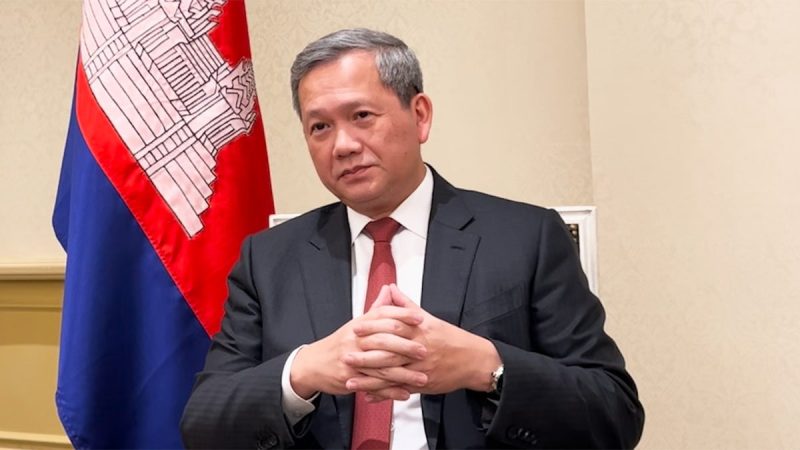
Last year when President Donald Trump helped broker a ceasefire agreement between Thailand and Cambodia, he took a victory lap.
‘Who else could say, ‘I’m going to make a phone call and stop a war between two very powerful countries, Thailand and Cambodia?” he said.
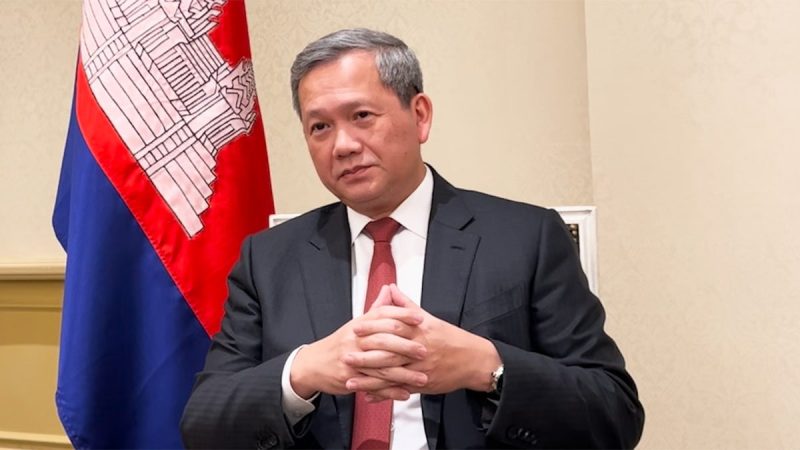
Now, that agreement appears under strain, as Cambodian Prime Minister Hun Manet told Fox News Digital that Thai forces have pushed into long-held Cambodian territory beyond the line of dispute. Thai soldiers have sealed off villages with barbed wire and shipping containers, leaving 80,000 Cambodian locals unable to return home, according to Cambodian officials.
‘The occupation is beyond even Thailand’s unilateral claim,’ Manet said. ‘Many of the villagers cannot go back to their hometowns.’
Cambodia and Thailand have sparred for decades over sections of their 500-mile land border, much of which was drawn during the French colonial era and later interpreted differently by Bangkok and Phnom Penh. The dispute has periodically flared into armed clashes, particularly around areas near historic Khmer temple sites and rural villages where demarcation remains incomplete.
Tensions escalated again last year, with fighting breaking out along contested stretches of the frontier and displacing thousands of civilians on both sides. The clashes prompted diplomatic intervention and culminated in a ceasefire agreement brokered with U.S. involvement during an ASEAN summit in Kuala Lumpur.
Images and local reporting from the most recent fighting show damage to structures near the frontier, including at or near the UNESCO-listed Preah Vihear temple complex — raising concerns about the safety of cultural heritage sites caught in contested zones. Cambodian officials have blamed Thai forces for the damage, while Thai officials have denied deliberately targeting religious or cultural landmarks, saying military operations were limited to contested security areas.
The Thai embassy could not be reached for comment on this interview.
Still, Manet declined to threaten military retaliation. ‘Our position is to always stick to peaceful resolutions,’ he said. ‘We don’t believe that using war to stop a war is sustainable or practical.’
Thailand, with a population of more than 70 million — roughly four times Cambodia’s 17 million — maintains a significantly larger and better-equipped military, raising the stakes of any renewed conflict.
With fighting again threatening fragile stability along the frontier, Manet traveled to Washington this week for the inaugural meeting of Trump’s Board of Peace.
‘The Board of Peace can play an active role in promoting peace, stability and normalcy between Cambodia and Thailand,’ he said.
Hun Manet took office in 2023, succeeding his father, Hun Sen, who ruled Cambodia for nearly four decades. The leadership transition marked the first formal handover of power in decades, though the ruling Cambodian People’s Party has maintained firm control over the country’s political system amid longstanding criticism from rights groups about limits on opposition activity.
A graduate of the U.S. Military Academy at West Point, Manet has sought to maintain close ties with China while cautiously reopening channels with Washington, including restoring joint military exercises that had been suspended in 2017.
As Cambodia navigates tensions with Thailand, it is also balancing relations between Washington and Beijing.
Manet said navigating ties with competing world powers ‘doesn’t have to be a zero-sum game’ and that Cambodia, as a smaller nation, cannot afford to ‘choose one country against the other.’
That balance has centered in part on Ream Naval Base, a strategic facility on Cambodia’s southern coast rebuilt with Chinese financing.
The USS Cincinnati docked at Ream in late January, marking the first U.S. warship visit since the base was renovated with Chinese funding and technical support. The visit was marked by a striking visual: the USS Cincinnati docked roughly 150 meters from a Chinese naval vessel already moored at the base. For years, U.S. officials have raised concerns that Cambodia had granted China exclusive access.
But Manet insisted the base remains under Cambodian control. ‘Our constitution says that no foreign military base [can] be situated on Cambodian soil.’
The U.S. visit, he said, ‘clearly shows that Cambodia is not exclusively used as a naval base for cooperation with China.’
Manet also confirmed that annual U.S.-Cambodia military exercises known as Angkor Sentinel, suspended in 2017, are set to resume this year — signaling warming defense ties. ‘We hope to have expanding cooperation with the U.S.’
In recent years, Cambodia has emerged as a hub for large-scale online scam operations, including so-called ‘pig butchering’ schemes that have defrauded victims worldwide — including Americans — out of billions of dollars. U.S. authorities have sanctioned Cambodian-linked entities tied to crypto fraud and pressed Phnom Penh to intensify enforcement efforts amid concerns about trafficking and forced labor linked to some compounds.
Manet said his government has stepped up cooperation with U.S. authorities and recently worked with the FBI to dismantle a major operation.
‘We have recently worked with the FBI cracking on a major case involving one of the Oknyaks,’ he said, referring to an influential Cambodian figure. ‘We arrested him, and we closed down one of the big compounds.’